|
🚀
Get Your First AI Automation FREE
Limited-time offer for qualified businesses.
|
Your app got traction with Cursor, Bolt, Lovable, or Replit. Now the cracks are showing, slow pages, mystery bugs, a codebase nobody fully understands. We fix the engineering underneath it, without starting over.
AI-generated changes fail in production, even after passing QA
Orgs report a major incident tied to AI code in 6 months
Of AI-generated code passes a security review
Exposed API keys found across 5,600 apps scanned
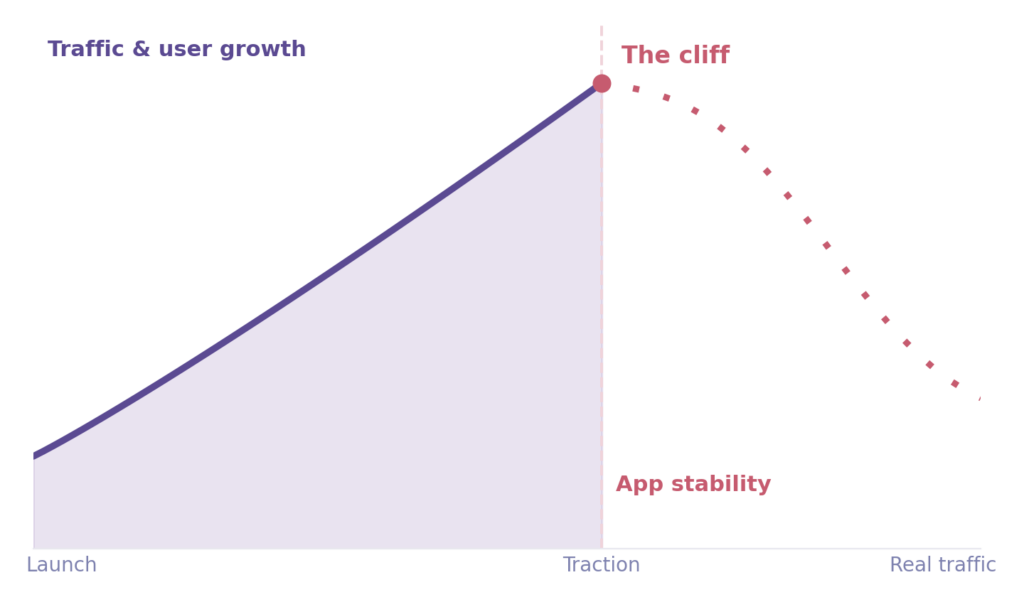
Vibe-coded apps typically skip the parts of engineering that don’t show up in a demo. The gap between “it works” and “it scales” doesn’t show up gradually, it shows up all at once, usually right after your best week of growth.
Our vibe coding scale-up services, in the order most teams actually need them.
We read through your entire AI-generated codebase line by line, mapping what's duplicated, fragile, or silently broken. You get a prioritized risk report, not a generic checklist.

We restructure the "everything in one file" logic vibe-coding tools tend to produce into clean, modular components maintainable by any developer, not just the AI that wrote it.

We add missing indexes, fix N+1 query patterns, set up connection pooling, and introduce caching so the app that felt instant with 10 test users still feels instant with 10,000 real ones.

We rebuild authentication and authorization so it checks permissions per resource, not just login state plus secrets management, environment separation, and input validation.

We containerize your application, set up CI/CD pipelines, configure logging and error tracking, and deploy on AWS, GCP, or Azure with autoscaling and load balancing.

Once the foundation is solid, we keep building new features and integrations on a codebase your team can own long-term, with documentation and tests in place.

Six reasons founders trust us to fix the engineering underneath their product instead of throwing it away.
A full rewrite is usually unnecessary. We rebuild from zero only when the data or auth model is fundamentally unsound.
We specialize in diagnosing missing indexes, unbounded queries, and locking issues before downtime hits.
We close authorization gaps and secure secrets without disrupting active users or delaying your roadmap.
Our team routinely works inside codebases produced by Cursor, Copilot, Lovable, and Bolt, so we recognize the patterns.
Every rebuild is designed for stateless, horizontally scalable infrastructure growth without another rewrite.
You get complete ownership of the refactored code, documentation, and infrastructure, with regular updates.
Turning an AI-built MVP into production-grade software means understanding what you’ve already built and evolving it deliberately.
The gaps AI tools leave behind, closed the right way.
Every route is rebuilt to check what a user is allowed to touch, not just whether they're logged in.
API keys and credentials move into proper secrets management.
Dev, staging, and production are cleanly split so testing mistakes never reach real users.
Changes are staged, tested, and released incrementally.
Only 10.5% of AI code passes as-is
A production-grade toolchain, matched to whichever AI tool built your app in the first place.
If an AI tool wrote your first version and real users are now finding the edges, this is built for you.
Three ways to work with us, depending on how well-defined your scope already is.


In the large majority of cases, it can be saved. We refactor and harden the existing codebase rather than rewrite it from scratch. A full rebuild is only necessary when the underlying data model or authorization design is fundamentally broken.
Common signs include pages that slow down as data volume grows, intermittent errors under concurrent use, and features that worked in testing but fail unpredictably in production. Our audit pinpoints the exact cause.
Often not by default. AI coding tools tend to check whether someone is logged in, but not whether they’re allowed to access a specific resource. We audit specifically for these authorization gaps.
No. We work in a staging environment identical to production, test thoroughly, and roll out changes incrementally so live users see no downtime.
A codebase audit typically takes one to two weeks. Full refactoring and hardening usually ranges from three to eight weeks for a typical MVP-to-production engagement.
Yes. Our engineers regularly work inside codebases generated by Cursor, Lovable, Bolt, Replit, Base44, and GitHub Copilot, and understand the blind spots specific to each.
Everything the refactored codebase, documentation, infrastructure configuration, and test suite are yours outright, with no vendor lock-in.
Absolutely. Most clients move into an ongoing dedicated-team engagement once the foundation is solid, so feature development continues without re-accumulating technical debt.